|
2011 Autumn Winter collection
Designed by Anamophée
Credits : Hermès.com |
キモノ・エクスリブリス
ジャポニズムの極致、ここに至れり。
色鮮やかなキモノ柄のコラージュ。
目を凝らせば、エクス・リブリスが浮かびあがる。
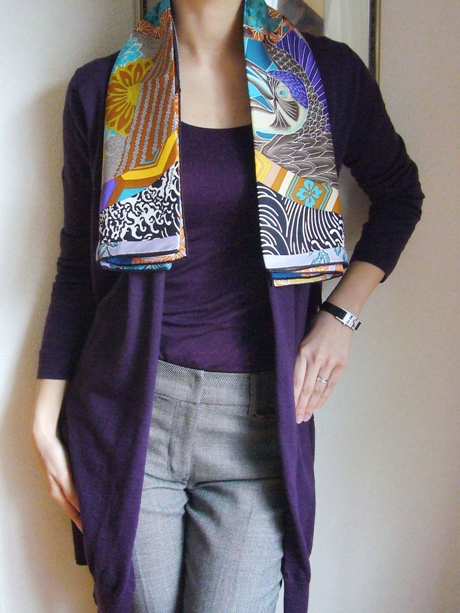
Sorti en automne 2011, signé de l'Anamophée, “Ex-Libris en Kimonos” atteint l'apothéose du japonisme. Avec un regard attentif, l’emblème de la maison se dessine en patchwork de kimonos.
Released in fall 2011, signed by Anamophée, "Ex-Libris en Kimonos" has reached the apotheosis of Japonisme. With a close observation, the emblem of the house emerges from the patchwork of kimonos.
 |
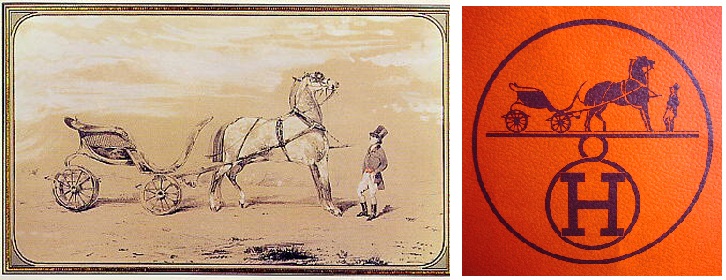
Drawing of Alfred de Dreux (1810- 1860)
Credits : www.leiweb.it |
メゾンの商標「四輪馬車と従者」。御者が描かれていないのは「エルメスは最高品質の馬車を用意しますが、御すのはお客様自身です」とのメッセージが込められているから。
L’Ex-libris illustrant «le duc attelé et groom à l’attente». Derrière l’absence du cocher se cache un message que c’est le client lui-même qui est le maître d’Hermès.
Ex-Libris illustrating "the Duc-carriage and groom." The absence of the coachman hides a message that the customer himself is the master of Hermes.
 |
冬も常緑を保つことから、不老長寿のシンボルとなった松。
Comme le pin reste toujours vert, il est un symbole de longue vie.
As pine is evergreen, it is a symbol of the long life. |
図案は、吉祥文様としてなじみ深い「松竹梅」「鶴亀」を中心に、日本の花鳥風月を彷彿とさせる構成だ。
吉祥文様の多くは、不老長寿のイメージと結びついている。
Des motifs porte-bonheurs de pins, de bambous et de pruniers, de grue et de tortues ornent l’ensemble. Ainsi apparaisse un paysage pittoresque du Japon d’antan.
Des motifs porte-bonheurs symbolisent souvent la longévité.
The square is decorated with auspicious motifs, such as pine, bamboo, and plum, cranes and turtles. Thus appears a picturesque landscape of old Japan.
The auspicious motifs often symbolize the longevity.
 |
常緑樹であり、すくすく育つ竹。
Le bambou, qui pousse vite, reste aussi toujours vert.
Bamboo, which grows fast, is also evergreen.
|
 |
春にさきがけ咲き誇る梅。生命力を象徴。
Les pruniers fleurissent en annonçant le printemps. Ils symbolisent la vitalité.
The blossom of the plum announces the spring. It symbolizes the vitality. |
 |
千年の命を持つとされる鶴。
La grue était censée vivre mille ans.
The crane has been believed to live a thousand years. |
 |
六角形の図案は、万年生きると言われた亀の甲羅を意匠化。
Le motif hexagonal représente la carapace de tortue, censée vivre dix mille ans!
The hexagonal pattern represents the turtle shell, supposed to live ten thousand years! |
大輪の花を咲かせるのは「菊」。
De grandes fleurs sont des chrysanthèmes.
Large flowers are chrysanthemums.
 |
薬草として用いられていた菊も、不老長寿に結びつく。
Utilisé comme médicament, le chrysanthème est un symbole de l’immortalité.
Used as a medicine, the chrysanthemum became a symbol of immortality. |
こうした叙情的風景を取り囲むように四隅を埋めるのが、「大波文様」。四方を海に囲まれた日本を暗示しているのかもしれない。
De grandes vagues, encadrant cette imagerie poétique, évoquerait le Japon entouré par la mer de tous côtés.
Large waves, framing this poetic imagery, evoke probably Japan surrounded by sea on all sides.
 |
日本の伝統意匠には、「さざ波」や「夕波」など、数多くの波文様がみられる。
La vague est un des leitmotivs de l’imagerie japonaise.
Il existe de nombreuses variations comme les rides ou les flots de soir.
The wave is a leitmotif of Japanese imagery.
There are many variations such as ripples or waves of the evening. |
アナモルフェの視線を介し、モダンな表情に生まれ変わったキモノ。
なにげない日常で、キモノをまとう悦びに満たされる。
Filtré par le regard de l’Anamorphée, le kimono change aujourd’hui toute son apparence. Modernisé, il peut se porter comme tenue de ville au quotidien!
Filtered through the eyes of the Anamorphée, the kimono changes today its whole appearance. Modernized, it can be worn as everyday attire!